HIKE California Trails

  • Point Reyes: Bear Valley and Arch Rock

    Point Reyes: Bear Valley and Arch Rock

    From Bear Valley Visitor Center to Arch Rock is 8.8 miles round trip

    What’s not to like about a fairly flat footpath that leads through lovely forest, across wide meadows and ends at a drop-dead gorgeous overlook above the ocean? No wonder Bear Valley Trail, a former wagon road, is one of the most popular paths in the national seashore.

    DIRECTIONS

    Bear Valley Visitor Center is located just outside the town of Olema, 35 slow and curving miles north of San Francisco on Highway 1. A quicker route is by Highway 101, exiting on Sir Francis Drake Boulevard, and traveling 20 miles to Olema. Turn right on Coast Highway 1, proceed 0.1 mile, then turn left on Bear Valley Road, which leads 0.4 mile to parking for the Point Reyes National Seashore Visitor Center and the trailhead.
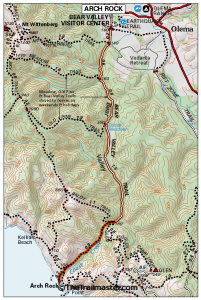
    Bear Valley and Arch Rock
    Point Reyes – Bear Valley Hiking Map by TomHarrisonMaps.com (click to enlarge)

    THE HIKE

    Bear Valley Trail leads through open meadow and, after 0.2 mile, passes a junction with Mt. Wittenberg Trail, which ascends Mt. Wittenberg.

    Beyond this junction, the trail enters a forest of Bishop pine and Douglas fir. Your path is alongside Bear Valley Creek. Notice that the creek flows north, in the opposite direction of Coast Creek, which accompanies Bear Valley Trail from Divide Meadow to the sea. This strange drainage pattern is one more example of how the mighty San Andreas Fault can shape the land.

    A half-mile along, pass a junction with Meadow Trail and, after almost another mile of travel, arrive at Divide Meadow, 1.6 miles from the trailhead. Well-named Divide Meadow divides Bear Valley Creek from Coast Creek. Bordered by Douglas fir, the meadow is a fine place for a picnic, as well as being a popular destination/turnaround point for many hikers. It’s also, literally, the hike’s high point (about 360 feet above sea level).

    Re-entering the forest, shady Bear Valley Trail continues another 1.5 mile to a junction with northbound Baldy Trail and southbound Glen Trail. At the 3.2-mile mark, Bear Valley Trail narrows from road to footpath (from which bikes are banned), and heads for the coast in the shade of Douglas fir.

    Four miles along, the trail ends at a junction with Coast Trail. Follow the signs to Arch Rock, past a second junction with Coast Trail.

    Near the ocean, the path crosses through coastal scrub and arrives at an open meadow on the precipitous bluffs above Arch Rock. Unpack your lunch and admire the sea stacks.

    Careful hikers can reach the arch by following a sketchy, eroded path down to Coast Creek, and then scramble over rocks to the ocean. The arch is accessible at very low tide. Keep an eye on the tides because you don’t want to get stranded on this beach.

    Be warned, though: Arch Rock, in the National Park Service view, is an overlook point with no beach access. For hikers who have just got to get to the beach, The Trailmaster recommends heading for Kelham Beach, accessible from Kelham Beach Trail, 0.8 mile north on Coast Trail.

    Interested in more hikes in Point Reyes National Seashore? Check out my guide: HIKE Point Reyes.
  • Point Reyes: Abbotts Lagoon

    Point Reyes: Abbotts Lagoon

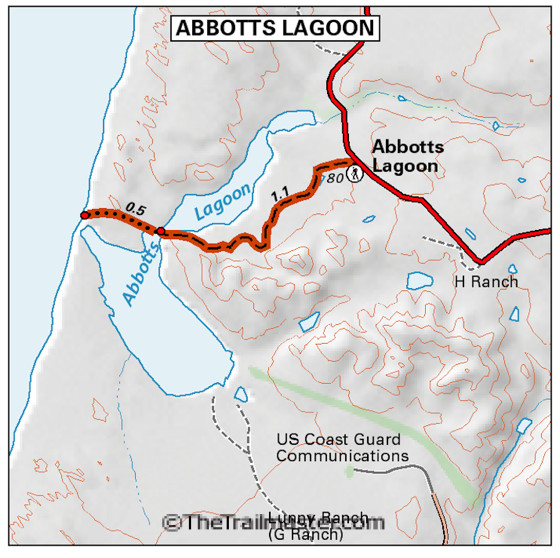
    From Abbotts Lagoon to Point Reyes Beach is 3.2 miles round trip

    Something about Abbotts Lagoon personifies the word melancholy. Maybe it’s the lagoon itself, a large, moor-like environment that compares to some of those I’ve visited by trail in Scotland. Then there are the lonely, wind-swept grasslands and the (perpetual, it seems) gray skies. It’s the kind of place you photograph in black and white.

    While a bit on the somber side, the lagoon and lands beyond are by no means dreary and depressing; in fact, the landscape encourages reflection—an inward journey to accompany a fine outer one. And spring is positively jubilant with abundant wildflowers, particularly California poppies, iris, and lots of lupine.

    On a weekday excursion, your thoughts may very well be your only companion on this rather lightly visited trail, which leads 1.6 miles to Point Reyes Beach. A low ridge hides Abbotts Lagoon from the sight of passing motorists on Pierce Point Road; this positioning seems to discourage drop-in visitation of the kind that occurs else-where along the coast of the national seashore.

    Gray-hued the lagoon may be, but it’s anything but lifeless. Lots and lots of birds, both migratory and year-around residents congregate in an upper freshwater lagoon and a more brackish lower lagoon. Look for the western grebe and its pint-sized cousin, the pie-billed grebe, as well as lots of coots and terns.

    If you can arrange a ride or car shuttle, a one-way hike (4.5 miles) from Abbotts Lagoon along the beach north to the Kehoe Beach Trailhead on Pierce Point Road is a great way to go.

    DIRECTIONS TO ABBOTTS LAGOON TRAILHEAD

    From the hamlet of Olema, head north just 0.1 mile on Highway 1, then turn left on Bear Valley Road. Proceed 2.25 miles and fork left on Sir Francis Drake Highway. Drive 5.5 miles to Pierce Point Road, fork right and continue another 3.2 miles to the signed Abbotts Lagoon Trail and gravel parking lot on the left (west) side of the road.

    Point Reyes: Abbotts Lagoon by TomHarrisonMaps.com (click to enlarge)
    Point Reyes: Abbotts Lagoon by TomHarrisonMaps.com (click to enlarge)

    THE HIKE

    THE HIKE: The wide, level trail leads across open fields. Gently rising, the trail offers better and better views of the lagoon. A well-located bench offers a fine place for quiet contemplation of water and wildlife.

    The trail crests about the 0.8 mile-mark, then descends slightly to reach a bridge a mile from the trailhead. The footbridge bisects the upper and lower lagoons or as more lyrical naturalists refer to it—the wings of the lagoon.

    From here an unmarked path edges around the base of the dunes between the wings of the lagoon to reach the ocean shores of Point Reyes Beach. Seals and sea lions have been known to snooze on this beach. Walk to your heart’s con¬tent for miles, up-coast or down.

    Northbound hikers can travel along the dune-lined beach about 2.8 miles to junction Kehoe Beach Trail, then hoof it another 0.6 mile to the trailhead on Pierce Point Road.

    Interested in more hikes in Point Reyes National Seashore? Check out HIKE Point Reyes

  • Sequoia: Deeper into Giant Forest

    Sequoia: Deeper into Giant Forest

    Congress Trail, Trail of the Sequoias: Congress Trail is 2-mile loop; Trail of the Sequoias is 5.1-mile loop with 500-foot elevation gain

    Many are the wonders of the John Muir-named Giant Forest, which holds the park’s greatest concentration of sequoias—more than 8,000 big trees. Begin by joining visitors from across the country and around the world on the short walk to General Sherman Tree, the world’s largest living thing. Next meander Congress Trail, is an interpreted nature trail that loops through the Giant Forest where four of the five largest trees dwell.

    Trail of the Sequoias is for the hiker looking for more—more Giant Forest, more hiking, and a little more tranquility. It’s not exactly off-the-beaten path, but it is a much-less traveled route.

    DIRECTIONS TO THE GIANT FOREST TRAILHEAD

    From Generals Highway, turn west on Wolverton Road and drive a half mile. Turn right for “Sherman Tree” and proceed 0.8 mile to the large parking lot.

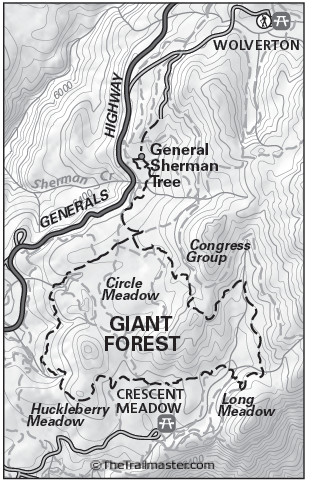
    Giant Forest Map by TomHarrisonMaps.com (click to enlarge)
    Giant Forest Map by TomHarrisonMaps.com (click to enlarge)

    THE HIKE

    Head down the paved path with many stairs and likely with lots of company 0.3 mile to pay your respects to the General Sherman Tree. The tree’s vital statistics: 275 feet high, 102 feet in circumference, between 2,300 to 2,700 years old. General Sherman is some 52,500 cubic feet in volume and weighs an estimated 2.8 million pounds.

    From the trailhead close to Sherman Tree, join signed and paved Congress Trail. Cross Sherman Creek on a wooden bridge and begin your tour of the giant sequoias, including aptly named Leaning Tree and some fire-scarred old veterans.

    Hikers from near and far wonder why so many magnificent trees in Sequoia National Park are stuck with the names of politicos and obscure presidents. The Washington Tree, named for revered first president, seems appropriate. But the McKinley Tree? The Cleveland Tree?

    Don’t look for the Bill Clinton Tree, George Bush Tree or Barack Obama Tree anytime soon; the national park service abandoned the practice of naming big trees after World War II.

    Paved Congress Trail leads a short mile to a junction with Trail of the Sequoias. Join this path for a half-mile ascent to this hike’s high point, then descend gradually 1.5 miles among more sequoias to Long Meadow.

    At the upper end of this meadow is Tharps Log, a cabin used for 30 summers until 1890 by cattle rancher Hale Tharp. From the cabin, you’ll join Crescent Meadows Trail, passing the severely scarred, but still standing Chimney Tree.

    Four miles out, join Huckleberry Trail for a brief climb, then follow signs to Circle Meadow, very shortly arriving at another trail junction. Trail of the Sequoias forks right (northeast), traveling a mile to the Senate Group and rejoining Congress Trail for the return to the General Sherman Tree trailhead.

    Interested in more hikes in Sequoia and Kings Canyon? Check out HIKE Sequoia and Kings Canyon

  • Sequoia and Kings Canyon: Eagle Lake, Mineral King

    7.2 miles round trip with 2,200-foot elevation gain

    Eagle Lake, a popular weekend backpacker destination, is reached by one of Mineral King’s easier trails. Relatively easier, that is. A 2,200- foot gain at high altitude in 3.5 miles is a good workout to say the least.

    The lake lies in cirque, a basin formed by glacial erosion. When the light is right, the lake mirrors some of its scenic surroundings: weathered foxtail pines and polished granite walls, their shaded cracks and crevices patched by long-lingering snow.

    Eagle, like many a Sierra lake, was “improved” to render it more reservoir-like. The Mt. Whitney Power Company built a rock dam to better control waters flowing down to their hydroelectric plant located near Three Rivers.

    The moderately steep path has three branches: to Eagle Lake; to Mosquito Lakes (see hike description); to White Chief Canyon.

    En route to Eagle Lake, you’ll encounter two strange waterways. The path crosses Spring Creek, which emerges as if from nowhere. Geologists speculate that it’s of subterranean origin. If the sudden appearance of Spring Creek isn’t strange enough, Eagle Lake Trail hikers also witness the disappearance of Eagle Creek into a large sinkhole. The creek reappears down the hillside, leading to speculation that is channeled through a network of underground passageways in the marble rock below ground and emerges as…Spring Creek?

    Very mysterious.

    Experienced hikers, familiar with cross-country travel, can make a loop of this hike: climb a ridge from Eagle Lake then descend into Mosquito Lakes Basin. You’ll arrive at Mosquito Lake #4 and follow the lake chain north until you join the Mosquito Lakes Trail that returns you to Mineral King.

    DIRECTIONS TO THE EAGLE LAKE TRAILHEAD

    From Highway 198, about 3 miles northeast of the town of Three Rivers, turn right (east) on Mineral King Road. (If you drive up to the park’s Ash Mountain entrance station, you’ve gone a tad too far; double back.) The mostly paved road (it reverts to dirt in several places en route) leads about 24 miles to the Mineral King Ranger Station. Continue east on Mineral King Road another 1.3 miles and across a wooden bridge to the trailhead parking area.

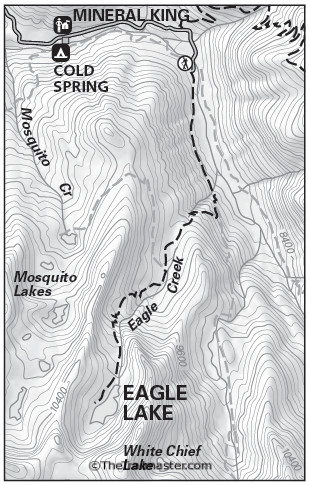
    Eagle Lake Map by TomHarrisonMaps.com (click to enlarge)
    Eagle Lake Map by TomHarrisonMaps.com (click to enlarge)

    THE HIKE

    Join the signed trail and soon view the restored “Honeymoon Cabin,” circa 1914. The path leads south along the East Fork of the Kaweah River and in 0.3 mile crosses the strange Spring Creek on a wooden footbridge. Look for Tufa Falls, a cascade so named for high levels of calcium carbonate in the waters.

    One mile out, at a junction with the trail to Eagle Lake/Mosquito Lakes, turn right, tackling steep switchbacks that climb a half-mile over fir-clad mountainside. Observe Eagle Creek’s disappearing act into a sinkhole and continue across a meadow to the junction with Mosquito Lakes Trail, two miles out. (See Mosquito Lakes hike.)

    Continue southwest toward Eagle Lake. Staying west of Eagle Creek, the trail switchbacks steeply, climbing white granite slopes and finally reaching the outlet of Eagle Lake.

    Interested in more hikes in Sequoia and Kings Canyon? Check out my guide: HIKE Sequoia and Kings Canyon