
Along Highway 395, a landscape of freedom shadows a history of confinement.
California Route 395, bordered on both sides by towering mountains, is one of America’s great roads.
I’ve driven it for more than a half century—through blizzards, desert heat, autumn aspens, and dawn departures for Eastern Sierra trailheads. Over the years I’ve watched it expand from a lonely two lane to a modern, multi-lane expressway.
A mixed blessing, perhaps. The now high-speed highway gives us less time to savor the scenery but quicker access to trailheads. As I drive north, I flashback to the arduous, lung busting trails I’ve hiked over high passes: Bishop, Baxter, Piute, Kearsarge, Sawmill. And the joy I’ve felt reaching lovely lakes—Sabrina, Desolation, Dingleberry, Hungry Packer, Golden Trout, and many more.
In Lone Pine, a turnoff leads to Whitney Portal, trailhead for the trek up mighty Mt. Whitney (14,505 feet), bringing back memories of the times I’ve succeeded—and failed—to reach the highest peak in the continental U.S. Just north of Lone Pine lies a place that changes the emotional temperature of the journey, that brings back memories of an altogether different kind of walk.
Manzanar.
Even after all these years, the name unsettles me.
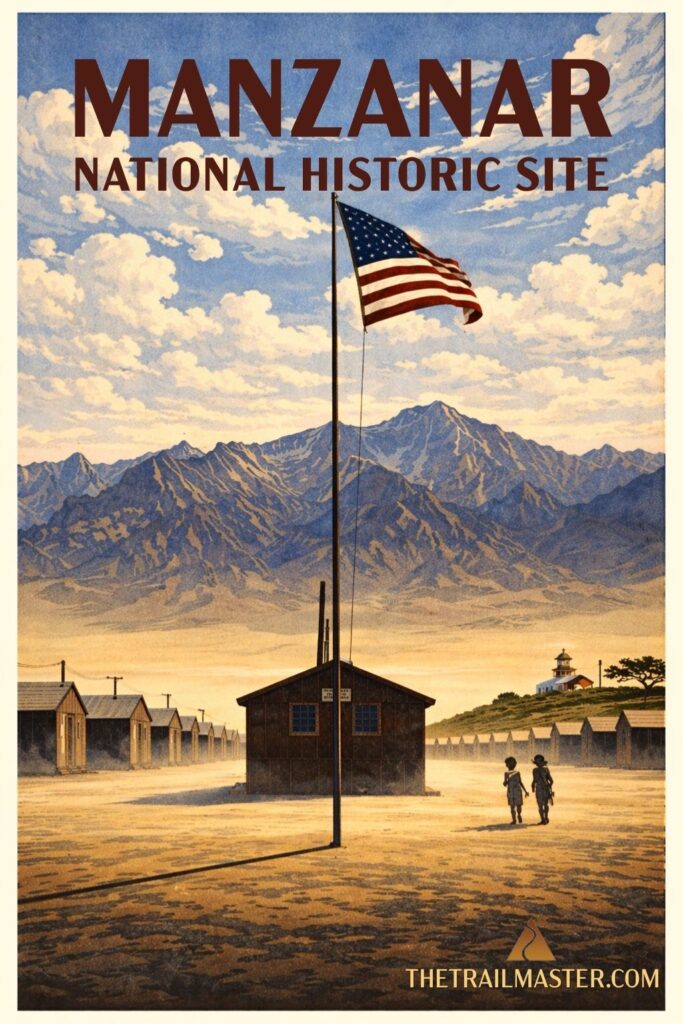
Maybe it’s the wind. I’ve walked the grounds of the former Japanese incarceration camp in winter cold and brutal summer heat. Always the wind seems to be blowing across the Owens Valley floor, rattling sagebrush beneath the Sierra crest. The mountains rise in magnificent silence behind the camp—as beautiful a landscape as California possesses.
Which somehow makes the history even harder to absorb.
Inside the Manzanar Visitor Center, located in the camp’s old auditorium, I find exhibits, photographs, and oral histories that put human faces to the story: children playing baseball in the dust, families gathered in mess halls, elders trying to carry on traditions under guard.
And then something stops me in my tracks: A sign requesting visitors use a QR code to anonymously report “any signs or other information that are negative about either past or living Americans.”
I stood there staring at it in disbelief. Manzanar exists precisely because history becomes dangerous when nations stop confronting uncomfortable truths.
I begin my walk among the ruins, reminders of one of the most difficult chapters in American history. A self-guided auto tour circles the camp’s perimeter, but many visitors like me choose to park and walk—wandering on foot feels more respectful.
Signs point out where the high school, camouflage net factory, Buddhist temple, Catholic church, and other structures once stood. The cement foundations, rock gardens, and irrigation ditches are quiet reminders of lives disrupted and communities uprooted.
As I walk, I struggle to understand the meaning of President Trump’s “Restoring Truth and Sanity to American History” executive order that forced our national parklands to display signs encouraging visitors to report “negative” historical interpretations about Americans. How do you interpret Manzanar without discussing racism, wartime hysteria, and political failure?
How does Lava Beds National Monument avoid discussing the war against the native Modoc? Or Harriet Tubman Underground Railway National Monument dodge discussing slavery?
“Manzanar” comes from the Spanish word for apple orchard. From 1910 to 1932, a farming community by that name grew apples and peaches here — said to be among the sweetest in the state — before Los Angeles claimed the water rights and sent it south through the Owens Valley aqueduct. The orchards dried up, the hamlet was abandoned, and Manzanar slipped into obscurity.
But as a World War II Japanese-American relocation camp, Manzanar became unforgettable. Beginning in 1942, more than 10,000 Americans of Japanese heritage — the majority of them U.S. citizens — were uprooted from their homes on the West Coast and confined here behind barbed wire and beneath eight 50-foot guard towers.
Families lived in tar-paper barracks that were broiling in summer, freezing in winter. Residents cultivated gardens, planted shade trees, and did what they could to make the camp feel like a community, but it was always a prison in all but name.
Walking this ground today, it is impossible not to feel the weight of that injustice. A plaque at the entrance puts it plainly: “May the injustice and humiliation suffered here as a result of hysteria, racism, and economic exploitation never emerge again.”
Hikers know the Sierra Nevada as a landscape of freedom. We head here to scale peaks, sleep beneath stars, disappear into silence.
At Manzanar, these same mountains become something else entirely. Backdrop. Barrier. Torment. Imagine staring every day at snow-covered peaks you could not approach. Imagine watching storms move across the range while armed guards stood behind you in watchtowers.
The beauty of the Eastern Sierra does not soften Manzanar. It sharpens it.
It’s hard not to think of the irony: people imprisoned in sight of such vast, open mountains. Hikers know the Sierra as a landscape of freedom and beauty. At Manzanar, you are reminded that landscapes can also hold memory — and memory isn’t always comfortable. That’s why it matters to walk here.
Past the mess hall, the barracks, the Manzanar Cemetery marked by the white “Soul Consoling Tower” erected by internees to honor those who died here.
I keep returning to Manzanar because walking here feels necessary. Necessary in the way difficult truths are necessary.
The wind still blows across the valley. Dust still rises beneath the Sierra crest.
Some national parklands ask us to admire beauty. Others ask us to remember who we are.
Some places we hike to escape the world. Others ask us to face it.
Footnotes
A few favorite hikes off Highway 395:
Devils Postpile National Monument
Mono Lake Tufa State Reserve