Every Trail Tells a Story


Año Nuevo State Park
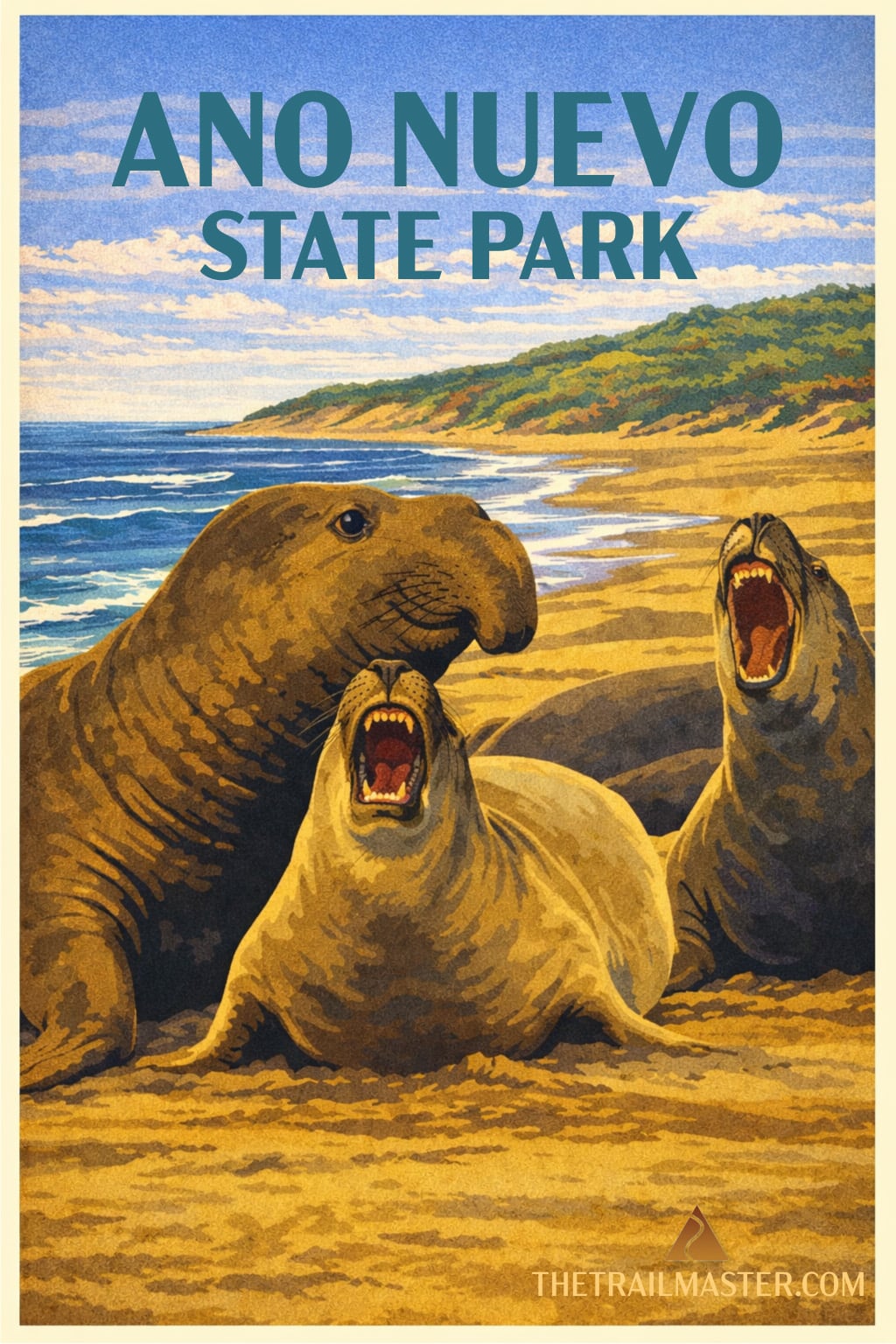
Witness one of the world’s great wildlife dramas-elephant seals in full, noisy, astonishing glory.
Walk through windswept dunes and historic ranchlands to the edge of the Pacific.
A living comeback story: from near-extinction to noisy abundance in just over a century.
If you want theater in the wild, Año Nuevo State Park delivers. The stage is a windswept sand spit north of Santa Cruz; the actors are thousands of elephant seals, every one of them oversized, loud, and astonishingly alive. It’s one of the great wildlife spectacles of the California coast, maybe of the entire Pacific Rim.
Come winter, males the size of minivans haul out on the beach, bellowing like foghorns and fighting bloody, brutal duels to decide who gets a harem. The dominant “alpha bulls” – weighing three tons, with battle scars to prove their worth – claim the prime territory. The losers slink away, nursing their wounds and waiting for a chance, however slim, to climb the pinniped social ladder. The females, leaner at a mere half-ton apiece, come ashore in January to give birth, nurse their pups, and mate again. It’s an ancient cycle of life and violence, tenderness and noise, playing out within earshot of Highway 1.
That it’s happening at all is a miracle. Elephant seals were once nearly hunted to extinction for their blubber oil – by 1900 only a handful remained. Now, thanks to protection and decades of recovery, Año Nuevo State Park hosts the world’s largest mainland rookery. The state park was established in 1958 precisely to protect this comeback story.
The landscape itself adds drama. The Spanish explorer Sebastián Vizcaíno named La Punta de Año Nuevo – Point of the New Year – on January 3, 1603. Sand dunes march to the sea, Ohlone middens whisper of a life sustained by shellfish and seabirds, and an old dairy barn now serves as the visitor center. This stretch of coast has seen redwood logs loaded onto schooners, cows grazing on blufftop meadows, and smugglers making use of its isolated coves. Today, the only contraband is the sight of a thousand seals, squabbling, snorting, and snoozing in the sand.
Beyond the main event, Año Nuevo rewards the patient observer. Western gulls, red-tailed hawks, and cliff swallows circle overhead. Monterey pines frame the dunes. In spring and summer, “yearling” elephant seals haul out to rest, while harbor seals and California sea lions loiter offshore. From December through March, visitors must join a guided walk with a docent-more than 200 trained volunteers keep both humans and seals safe. April through November, you’re free to hike out on your own to the viewing points, binoculars in hand. Either way, you’ll leave with a story to tell.
Año Nuevo State Park is located just west of Highway 1, 22 miles north of Santa Cruz and 30 miles south of Half Moon Bay.
The hike is not long but it’s never dull. From the visitor center, walk through coastal scrub and grassland, then crest a dune for your first sweeping view of Año Nuevo Point. Trails fan out toward several viewing areas; docents are stationed to explain what you’re seeing. The footing can be sandy, and one tall dune requires a bit of effort, but the route is mostly flat. Guided tours cover about 3 miles; self-guided hikes, available outside breeding season, extend up to 4 miles round trip. Along the way, expect brisk winds, squawking gulls, and that first unforgettable sight of a beach blanketed with seals.