Every Trail Tells a Story

Bear Harbor and Beyond
John McKinney · The Trailmaster
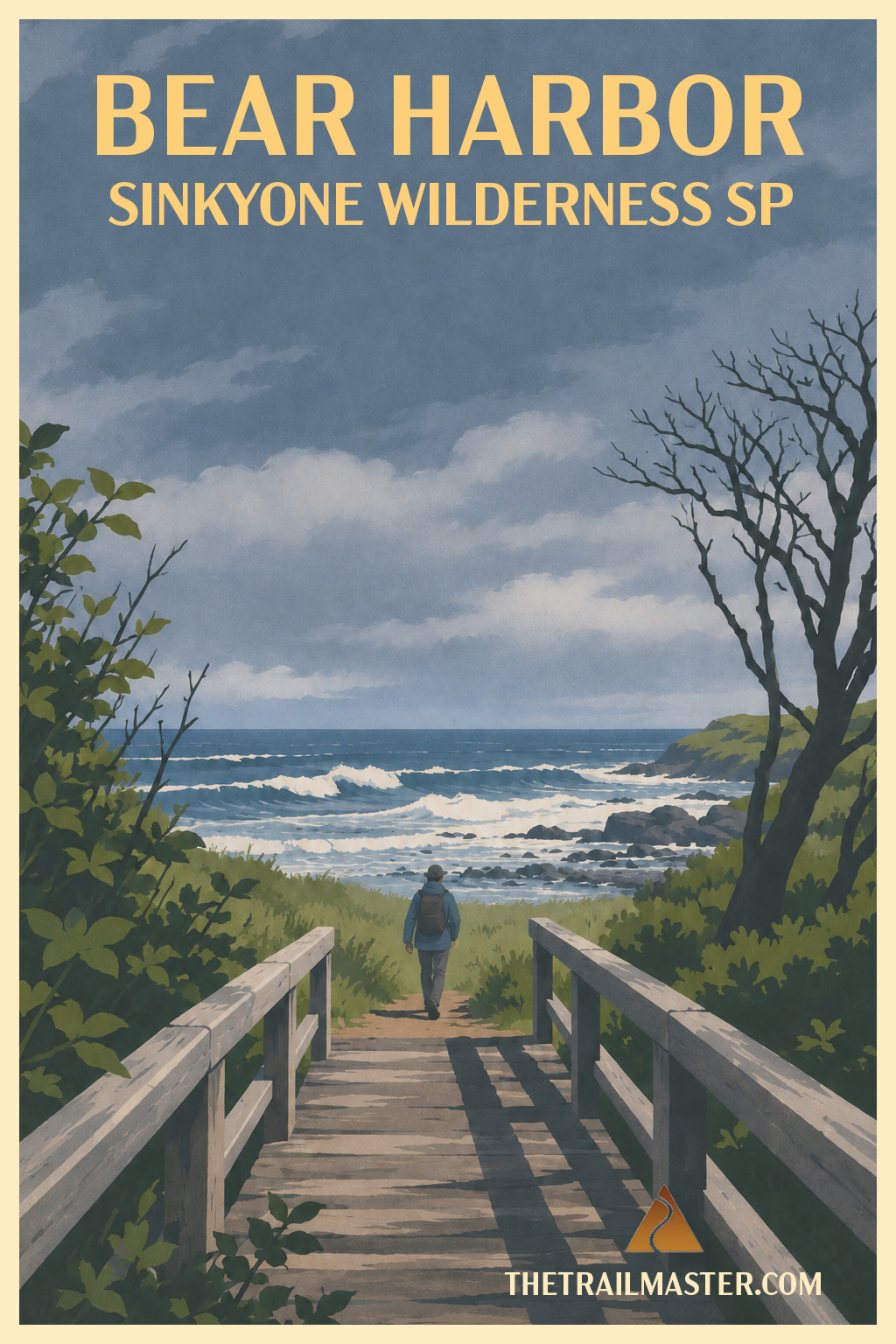
A railroad lost to the Lost Coast—and a hiking trail gained.
Splendid sampler of the legendary Lost Coast Trail.
A forgotten trail writer gets his own redwood grove.
Rusted rails dangling from the cliffs at Bear Harbor and faint traces of a railbed in Railroad Canyon are about all that remain of one of the most ill-fated logging railroads ever built. The Bear Harbor and Eel River Railroad was supposed to carry timber from the redwood forests to schooners waiting offshore.
Instead, calamity followed calamity. A Pacific storm destroyed the wharf in 1899, timber baron Harvey Anderson was killed in an industrial accident in 1905, and the San Francisco earthquake of 1906 finished off much of the track and trestles.
Apparently, the Lost Coast wasn’t particularly interested in becoming an industrial corridor.
Here, the mountains tumble toward the Pacific in a succession of forested ridges, grassy headlands and deep, shadowy gulches. The Lost Coast Trail marches up and down through this unruly country, seldom escaping the sound of surf pounding the rocks far below.
Spring is especially glorious. Coastal meadows bloom with lupine, buttercups, paintbrush and Douglas iris, while the forest floor comes alive with ferns and delicate calypso orchids. In the cool redwood groves, sword ferns spread their green fronds beneath immense trunks, and redwood sorrel carpets the ground with heart-shaped leaves. These little woodland plants fold their leaves when sunlight becomes too intense—an admirable strategy I’ve occasionally considered adopting myself.
The hike to Bear Harbor is rewarding enough, but for me the real treasure lies farther south, where the trail drops into Duffy’s Gulch and enters a grove of magnificent old-growth redwoods. Some of these trees were already centuries old when the railroad arrived, and somehow they escaped the logging that transformed so much of this coast.
I had the pleasure of naming a portion of this sanctuary the J. Smeaton Chase Redwood Grove, honoring a writer whose footsteps—and hoofprints—I’ve followed with great admiration.
In 1912, Chase traveled the California coast on horseback from Mexico to Oregon, recording his adventures in California Coast Trails, published in 1913. He was a wonderfully observant naturalist, an eloquent champion of wild places and a fellow who understood that a trail is much more than a way of getting from one place to another. A century later, his writing still speaks to those of us who prefer slow-speed sojourns along the California coast.
Chase deserves to be remembered, and I can think of no finer monument than living redwoods. There’s something satisfying about walking from the ruins of an industry that cut down trees to a grove honoring a man who wrote so beautifully about them.
From US 101 at Redway, take Briceland Road west toward Whitethorn and Needle Rock in Sinkyone Wilderness State Park. The road becomes Mendocino County Road 435. Continue to Needle Rock Visitor Center, approximately 36 miles southwest of Redway. The final 3.5 miles are steep, narrow and unpaved. High clearance is advisable; the road can become impassable in wet weather. Park by the Needle Rock Visitor Center.
From Needle Rock, follow the former road south through coastal meadows and spruce-fir forest, enjoying views toward Shelter Cove and the King Range. Cross several wooded ravines, then descend to Flat Rock Creek before climbing toward High Tip. The trail passes wildflower-covered slopes and overlooks Morgan Rock and other offshore formations.
At Orchard Creek Camp, about 2.4 miles out, the broad road gives way to narrower trail. Continue through eucalyptus trees and remnants of the old railroad grade to Bear Harbor Camp. Take the spur to the beach.
For the redwood grove, continue south on the Lost Coast Trail. Expect dense brush, poison oak, fallen trees and steep climbing. After traversing forested slopes, descend into Duffy’s Gulch, where old-growth redwoods tower above a fern-lined creek.